
The Establishment and Evolution of the Nationalsozialistische Deutsche Arbeiterpartei (NSDAP): Labour Nationalism, Power, and the Machinery Behind Adolf Hitler

The Nationalsozialistische Deutsche Arbeiterpartei (NSDAP), or National Socialist German Workers’ Party, is often remembered solely through the image of Adolf Hitler standing before enormous crowds beneath swastika banners. Yet Hitler, despite becoming the central figure of the movement, did not construct the party alone. The NSDAP emerged through an interconnected network of nationalist organisers, propagandists, industrial financiers, paramilitary leaders, military figures, and ideological architects who collectively shaped the movement into a modern authoritarian force.
The rise of the NSDAP was not simply the story of one man imposing his will upon Germany. Rather, it was the convergence of social despair, political opportunism, nationalist mythology, and organisational discipline flowing together into a single political current. Hitler became the face of that current, but many historians have observed that others composed the music to which he moved.
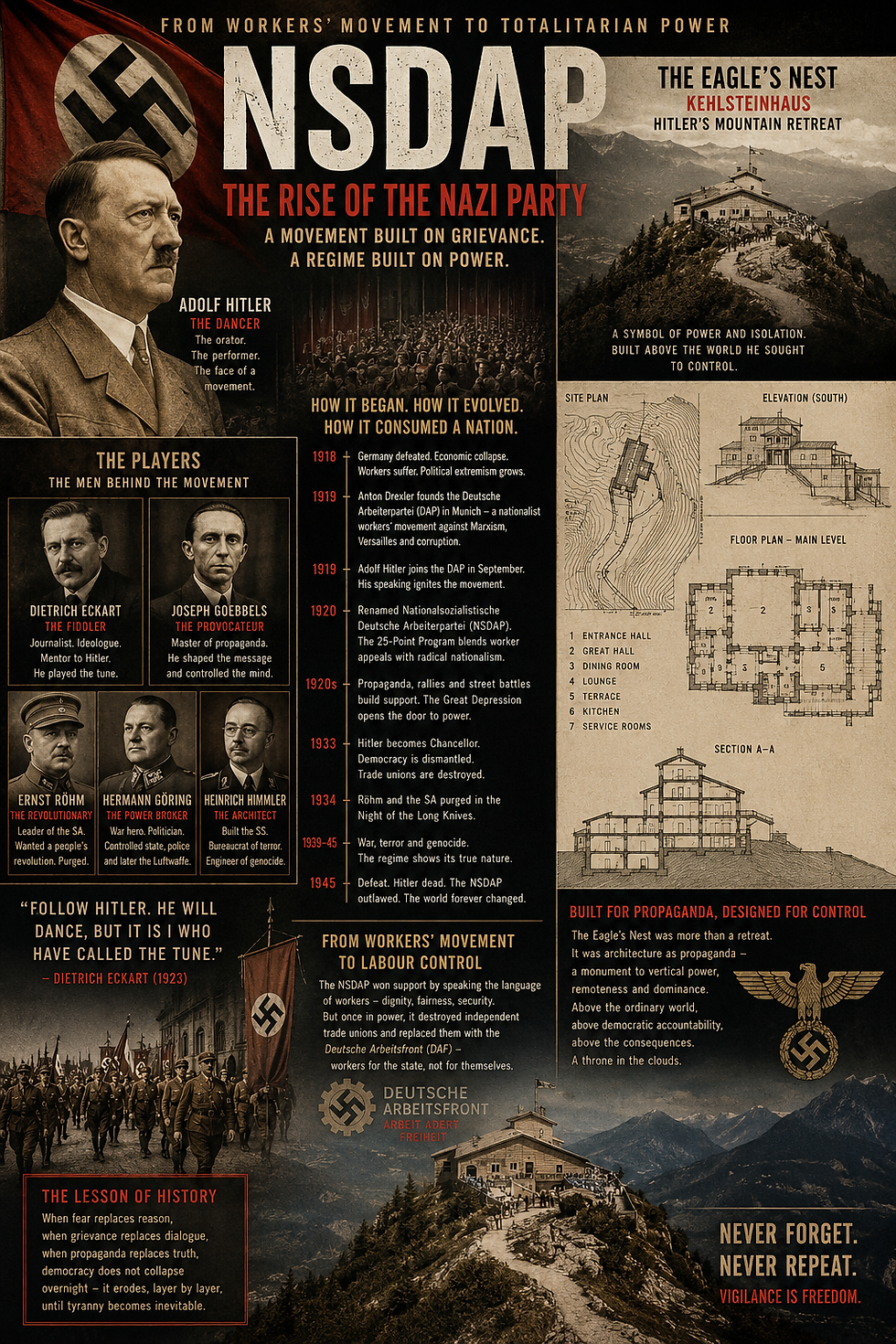
One frequently repeated historical characterisation — though partly metaphorical and debated in exact origin — described Dietrich Eckart as “the fiddler” and Hitler as “the dancer.” The phrase captures an important truth about the formative years of the Nazi movement: Hitler was profoundly shaped, mentored, and politically cultivated by influential nationalist intellectuals and organisers before he became the unchallenged Führer.
Germany’s Fractured Landscape After 1918
Germany after the First World War resembled a society in collapse. Millions of veterans returned home to find unemployment, hunger, inflation, and political violence. Communist uprisings erupted in major cities while right-wing nationalist militias formed in response. Confidence in parliamentary democracy weakened rapidly.
Workers were particularly vulnerable during this period. Labour unrest intensified throughout Germany as trade unions and socialist organisations expanded their influence. Industrial strikes became increasingly common, and many conservatives feared Germany would follow the Bolshevik revolutionary path established in Russia after 1917.
It was within this unstable environment that nationalist worker organisations began to emerge.
The Early Workers’ Movement
Anton Drexler and the German Workers’ Party
The movement that would later become the NSDAP originated in January 1919 as the Deutsche Arbeiterpartei (DAP) — the German Workers’ Party.
The principal founder was Anton Drexler, a railway locksmith and nationalist political organiser deeply connected to worker-oriented nationalist circles in Munich. Drexler believed traditional conservative elites had failed ordinary German workers, yet he also rejected Marxism and socialist internationalism.
Drexler envisioned a nationalist workers’ movement that would:
unite German labourers through patriotism rather than class struggle;
oppose communism;
resist international finance capitalism;
restore German national pride;
protect German industry and workers.
The DAP therefore operated initially almost like a nationalist labour association or proto-union movement aimed at reclaiming workers from socialist trade unions.
The irony of history is significant here: the movement that later destroyed organised labour first sought legitimacy through labour identity itself.
Dietrich Eckart — The “Fiddler”
Among the earliest and most influential figures surrounding Hitler was Dietrich Eckart.
Eckart was:
a journalist;
playwright;
poet;
nationalist intellectual;
fierce anti-Semite;
member of occult-nationalist circles linked to the broader völkisch movement.
He became one of Hitler’s earliest mentors after Hitler joined the DAP in 1919.
Eckart recognised Hitler’s extraordinary speaking ability before many others did. More importantly, he understood how emotionally powerful Hitler could become if politically refined and strategically guided.
Eckart introduced Hitler to:
wealthy nationalist patrons;
influential social circles;
Munich conservatives;
military sympathisers;
nationalist intellectual networks.
He also reportedly helped shape Hitler’s public speaking style, political image, and ideological framing.
It is from this relationship that the famous metaphor emerged describing Eckart as “the fiddler” and Hitler as “the dancer.” The suggestion was that Eckart played the ideological tune while Hitler performed the public spectacle. Whether stated exactly in those terms historically or later popularised symbolically, the metaphor reflects the widely acknowledged reality that Hitler was heavily cultivated during the movement’s formative years.
Eckart himself allegedly stated shortly before his death in 1923:
“Follow Hitler. He will dance, but it is I who have called the tune.”
The authenticity of the precise wording is debated among historians, but the sentiment accurately reflects Eckart’s influence over Hitler’s early political development.
Adolf Hitler — The Performer of Political Rage
When Hitler entered the movement in September 1919, he was largely unknown — a former corporal with little formal education, few social connections, and no established political career.
What distinguished Hitler immediately was not intellectual originality, but emotional performance.
He possessed:
exceptional rhetorical instinct;
intuitive crowd manipulation;
theatrical timing;
capacity to channel collective grievance into emotional unity.
Hitler understood something many politicians did not: people devastated by instability often respond more strongly to identity and emotion than policy detail.
His speeches fused:
worker resentment;
nationalism;
humiliation over Versailles;
anti-communism;
anti-Semitic conspiracy narratives;
promises of national rebirth.
This fusion became the emotional engine of the NSDAP.
The Renaming into the NSDAP
In February 1920, the DAP was renamed the Nationalsozialistische Deutsche Arbeiterpartei.
The name itself was strategic propaganda.
“National Socialist” was deliberately designed to attract:
workers;
unemployed labourers;
veterans;
lower-middle-class Germans fearful of economic collapse.
The party attempted to occupy political space between conservative nationalism and revolutionary socialism.
However, its “socialism” was never based upon worker ownership or democratic labour organisation. Instead, it sought to subordinate all classes into a racially unified authoritarian state.
Other Main Players in the Rise of the NSDAP
Joseph Goebbels — The Architect of Propaganda
Joseph Goebbels became one of the most critical figures in the movement’s expansion.
Originally intellectual and highly educated, Goebbels mastered:
emotional propaganda;
media manipulation;
mass psychology;
political theatre.
Under Goebbels, the NSDAP transformed propaganda into a modern weapon using:
newspapers;
posters;
film;
radio broadcasts;
rallies;
symbolism;
repetition.
Goebbels understood that political movements succeed not merely by argument, but by narrative saturation.
Hermann Göring — Militarisation and State Power
Hermann Göring, a decorated First World War fighter pilot, became instrumental in militarising and institutionalising Nazi power.
He later controlled:
the Gestapo in its early stages;
major police powers;
economic and military structures;
the Luftwaffe.
Göring helped bridge the gap between radical street politics and state authority.
Heinrich Himmler — Architect of Terror
Heinrich Himmler transformed the SS from a small bodyguard unit into one of the most feared organisations in history.
Under Himmler:
concentration camps expanded;
racial policies intensified;
state terror became systematised;
genocide became bureaucratically organised.
Himmler represented the administrative evolution of Nazi extremism — turning ideology into industrialised persecution.
Ernst Röhm — The Revolutionary Street Force
Ernst Röhm led the SA (Sturmabteilung), the Brownshirts.
The SA functioned as:
paramilitary enforcers;
rally organisers;
intimidators of political opponents;
street fighters against communists and unions.
Röhm believed the Nazi movement should remain revolutionary and worker-oriented. He envisioned a more radical transformation of German society, including elements hostile to traditional elites and military leadership.
Ironically, Röhm’s influence eventually threatened Hitler’s alliance with industrialists, conservatives, and the military establishment.
This culminated in the “Night of the Long Knives” in 1934, where Röhm and numerous SA leaders were executed under Hitler’s orders.
The Destruction of Independent Labour
Despite beginning as a nationalist workers’ movement, the NSDAP destroyed independent labour organisations almost immediately after consolidating power.
On 2 May 1933:
trade union offices were occupied;
union funds seized;
labour leaders arrested;
strikes outlawed.
The Deutsche Arbeitsfront (German Labour Front) replaced free unions entirely.
Workers became instruments of the state rather than independent participants within industrial relations.
This marked one of the great contradictions of the NSDAP:it rose partially through worker grievances while simultaneously abolishing genuine worker representation.
Industrialists and Conservative Elites
The NSDAP’s rise was also enabled by wealthy industrialists and conservative political figures who believed Hitler could suppress communism while preserving capitalist structures.
Many elites underestimated Hitler.
They viewed him as:
useful;
controllable;
temporary.
Instead, Hitler absorbed the state itself.
The flow of power became irreversible once conservative institutions surrendered democratic safeguards in exchange for political stability and anti-communist security.
The Psychological Flow of Authoritarianism
The evolution of the NSDAP did not occur through one dramatic moment alone. It developed progressively and fluidly.
Economic collapse led to resentment.Resentment flowed into nationalism.Nationalism flowed into scapegoating.Scapegoating flowed into authoritarianism.Authoritarianism flowed into militarisation and genocide.
This laminar progression is historically important because it demonstrates how societies can gradually normalise extremism when fear, instability, and identity politics override democratic principles.
The NSDAP’s rise therefore cannot be understood merely as the story of Hitler. It was the interaction of:
ideologues;
propagandists;
financiers;
paramilitary organisers;
political opportunists;
disillusioned workers;
frightened citizens.
Hitler became the central performer, but the machinery behind him was extensive, organised, and deeply embedded within the fractures of German society itself.
Conclusion
The Nationalsozialistische Deutsche Arbeiterpartei originated as a small nationalist workers’ movement attempting to attract labourers dissatisfied with post-war Germany and fearful of socialist revolution. Through strategic propaganda, emotional nationalism, and exploitation of economic despair, the movement evolved into a totalitarian political force.
Figures such as Anton Drexler, Dietrich Eckart, Joseph Goebbels, Hermann Göring, Heinrich Himmler, and Ernst Röhm each played distinct roles in shaping the movement’s direction and structure. Among them, Dietrich Eckart remains especially significant as the intellectual mentor often metaphorically described as the “fiddler” while Hitler became the “dancer” performing before the masses.
The evolution of the NSDAP remains one of history’s clearest warnings concerning how worker dissatisfaction, economic instability, nationalism, propaganda, and fear can be woven together into authoritarian movements capable of dismantling democracy itself.


Comments